Bitcoin Cash in SSP: Addresses That Look Like Bitcoin's, and Why That Matters
Most chain guides start with what the asset is for. This one starts with a hazard, because Bitcoin Cash has a property that can genuinely cost you money and it is not obvious from any wallet screen.
Bitcoin Cash inherited Bitcoin's address format. In its original form, a Bitcoin Cash address and a Bitcoin address are indistinguishable.
The ambiguity the fork left behind
When Bitcoin Cash split from Bitcoin in 2017, it kept the existing address encoding — the same version bytes, the same base58 alphabet, the same shape. That was the path of least resistance at the time. It also meant that for the first months of the chain's life, there was no way to look at an address and know which network it belonged to.
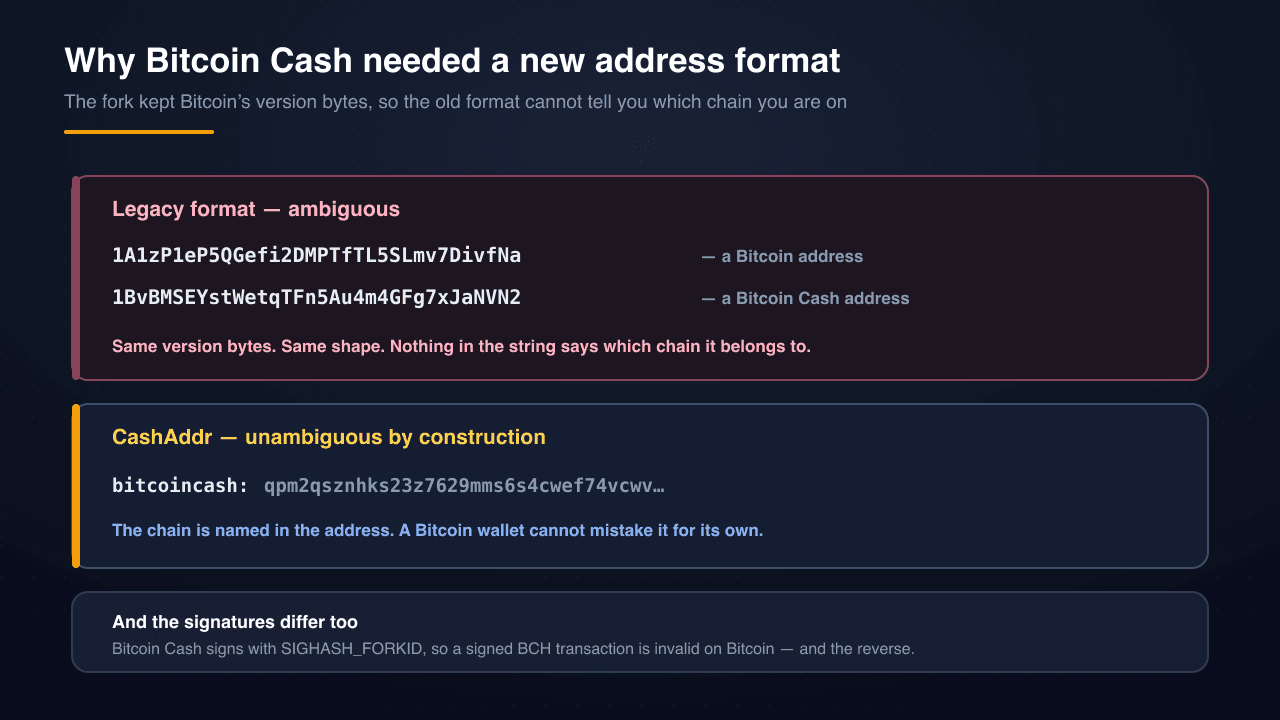
The consequence is the failure mode everyone remembers from that era: people sent BCH to Bitcoin addresses and BTC to Bitcoin Cash addresses, because both looked correct and both were correct — just for the other chain. The funds were not destroyed, but recovering them required controlling the corresponding key on the other network, which many people did not.
The fix was CashAddr, an address format that names its own chain. A modern Bitcoin Cash address carries the bitcoincash: prefix, and the body uses a different alphabet from Bitcoin's. It cannot be mistaken for a Bitcoin address by a human or by a wallet, which is the entire point of it.
SSP uses CashAddr throughout. If you are looking at a Bitcoin Cash address in SSP, its chain is written on the front.
What protects you at the protocol level
The address format solves the human problem. A separate mechanism solves the machine problem.
Bitcoin Cash signs its transactions with a modified signature-hashing scheme — SIGHASH_FORKID — which means a signed Bitcoin Cash transaction is simply invalid on Bitcoin, and a Bitcoin transaction is invalid on Bitcoin Cash. This is replay protection, and it was part of the fork from day one.
It matters because both chains share history. Every address that existed before August 2017 exists on both, with the same key controlling both balances. Without replay protection, a transaction broadcast on one chain could be rebroadcast on the other and spend the matching coins. SIGHASH_FORKID makes that structurally impossible rather than merely unlikely.
SSP sets this signature type on every Bitcoin Cash transaction it builds. You will never see it, and that is the correct outcome.
How SSP handles Bitcoin Cash
Bitcoin Cash never adopted segwit, so your 2-of-2 vault uses P2SH — the same script type SSP uses for Dogecoin and Flux, and derived from the same seed as everything else under a two-of-two arrangement identical to the rest of the wallet.
Fees are close to nothing. SSP defaults to 4 units per byte — the lowest default of any Bitcoin-derived chain in the wallet, and about a twenty-fifth of Bitcoin's — because Bitcoin Cash's blocks are very large and very empty. The dust limit is the familiar 546 units, and SSP caps any single Bitcoin Cash fee at 0.01 BCH as a backstop against a runaway bug.
One difference from Bitcoin and Litecoin: Bitcoin Cash does not support replace-by-fee. A transaction cannot be bumped to a higher fee after broadcast. In practice this is close to irrelevant — with blocks this empty, a transaction at the default rate confirms in the next block or two — but it means the fee you set is the fee you have.
What Bitcoin Cash is actually for
The honest framing is that Bitcoin Cash is a bet on a specific answer to a question Bitcoin answered differently.
The question was how Bitcoin should scale. Bitcoin's answer was to keep blocks small, accept a fee market, and push volume to layers built on top. Bitcoin Cash's answer was to make blocks much larger and keep transactions cheap on the base layer. Both were defensible engineering positions. The split happened because they are mutually exclusive.
Where things stand now is not really in dispute: Bitcoin won the network effect by an enormous margin, and Bitcoin Cash retained a small fraction of the market and the developer base. That is not an argument that the technical position was wrong — cheap on-chain transactions are genuinely useful, and BCH delivers them — but it does mean that holding BCH is a bet on an outcome that has largely already been decided against.
What it does well is what it was built for: fast, extremely cheap on-chain payments with no layer-two involvement and no fee anxiety. If that is what you want from it, it does the job. If you are holding it expecting to catch up to Bitcoin, the last several years are informative.
Getting started
Bitcoin Cash appears in SSP's chain switcher alongside every other supported network, derived from the seed you already backed up. Balances and history behave like the other UTXO chains.
The practical notes, in order of how much they can cost you:
Always use the CashAddr form. SSP gives you one. If someone sends you a legacy-format address to pay, ask for a CashAddr — not because SSP can't handle it, but because the ambiguity is precisely the thing that has cost people money.
Double-check the chain before sending. This is general advice everywhere, but on Bitcoin Cash the historical failure mode makes it worth repeating. Transaction simulation covers what the wallet checks on your behalf before you sign.
Don't worry about the fee, but do get it right first time, since there is no replace-by-fee to fall back on.
For the click-by-click walkthrough, sending Bitcoin Cash with SSP picks up from here.