Comparing Self-Custody Options
Everyone who decides to hold their own crypto runs into the same question a week later: hold it how? A seed phrase in a drawer, a hardware device, a wallet that splits your key across servers, a multisig setup that needs several approvals — these are genuinely different security models, not different brands of the same thing.
This article compares them honestly, including where each one is the right answer. SSP is a 2-of-2 multisig wallet, so we have an opinion, but a comparison that only makes one option look good is not a comparison. If you are earlier than this decision, what is a crypto wallet is the place to start.
What you are actually choosing between
Strip away the marketing and every self-custody setup is answering two questions.
How many secrets can steal your money? If the answer is one — one seed phrase, one device, one file — then anyone who obtains that secret takes everything, and no amount of care changes the shape of the risk.
How many secrets can lose your money? If losing a single thing means the funds are gone forever, your setup has a single point of failure in the other direction.
Good setups push both numbers away from one. The catch is that pushing them apart usually makes daily use worse, and a security model you stop using is not protecting anything. That trade-off is the whole subject.
One key, one device
The default: a wallet app generates a seed phrase, the phrase controls everything, and you write it down.
What it protects against. Exchange failure, account freezes, and anyone who cannot reach your phrase. Compared with leaving coins on an exchange, this is a real improvement — the seven failure modes exchanges can suffer covers what you are stepping away from.
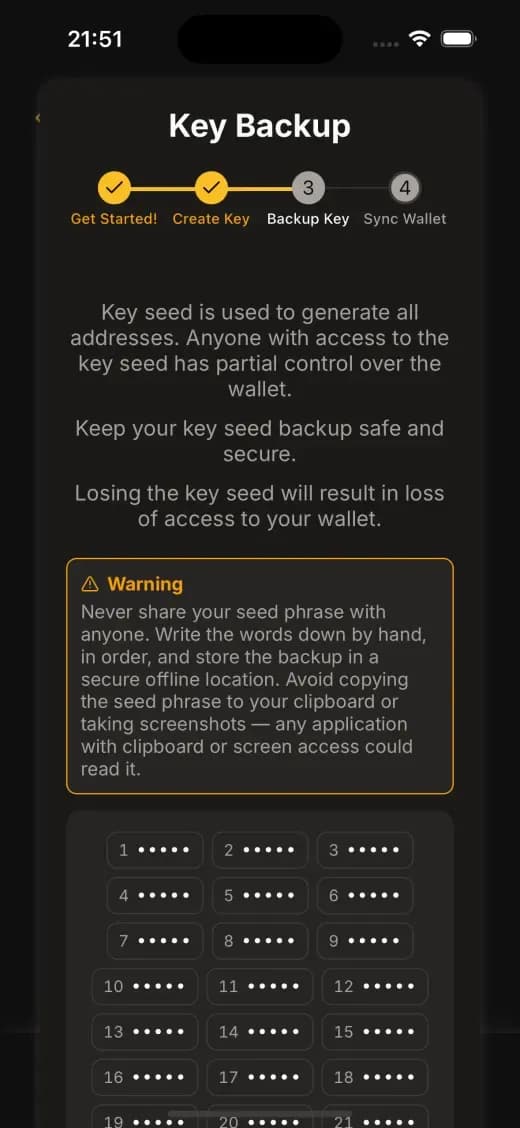
What it does not protect against. Anyone who obtains the phrase. That includes malware on the device that generated it, a photo of it in cloud backup, a household member who finds the paper, and a convincing phishing site that asks you to "verify" it. One secret, total control.
It is the right answer for small balances, for learning, and for anyone whose realistic threat is losing access rather than being targeted. Follow seed phrase best practices and it is genuinely fine at that scale.
A hardware wallet: moving the key offline
A dedicated device keeps the private key in a chip that never exports it. Transactions are signed on the device and you approve them on its own screen.
What it protects against. Malware on your computer. This is a big category — it removes the single most common way ordinary users lose funds.
What it does not protect against. It is still one key. Physical theft plus coercion, a compromised recovery phrase, a supply-chain-tampered device, or you approving a malicious transaction on a small screen without reading it carefully — all still work. Adding a passphrase creates a second secret, but also a second thing to lose; passphrase vs no passphrase covers that trade honestly.
Hardware wallets are a genuine step up and a reasonable choice for many people. Software wallet vs hardware wallet goes deeper on the comparison, and hot wallet vs cold wallet covers the storage question they raise.
MPC and smart-account wallets: splitting the key
Multi-party computation wallets take a different route. Rather than requiring multiple signatures, they split a single key into shares held in different places and use cryptography to produce one signature without ever reassembling it. Many "no seed phrase" consumer wallets work this way.
What it protects against. Compromise of any single share. It is a real improvement over one key in one place, and the user experience is often excellent — no seed phrase to write down, easy recovery.
What to look at carefully. Two things. First, who holds the other share. If one share sits with the wallet provider, then that provider's continued cooperation is part of your security model, and possibly part of your ability to spend at all. Second, what the chain sees. MPC produces a signature that looks like any other single-key signature, which is good for privacy and fees, but it also means the policy — how many shares, held by whom — exists only in the provider's software, not on-chain. If the provider changes or disappears, you rely on their recovery path.
That is not an argument that MPC is bad. It is an argument that "split key" and "multiple independent approvals" are different guarantees, and it is worth knowing which one you bought.
Multisig: requiring more than one key
Multisig is enforced by the blockchain itself. The address is derived from a policy — say, two of these three keys must sign — and the network rejects anything that does not satisfy it. No software can decide otherwise.
What it protects against. One compromised key. An attacker with one of your keys has exactly nothing; they need a second, held somewhere else, protected differently.
What it costs. Complexity. You now have multiple keys to manage, back up, and keep available. Classic multisig setups also often lean on a coordinator service to assemble signatures, and if that service disappears you need to know how to recover without it.
What is multisig, and why it matters covers the model, and 2-of-2 vs 2-of-3 vs m-of-n covers picking a threshold. Bitcoin Optech's multisignature overview is a good neutral technical reference.
Where SSP sits
SSP is a 2-of-2 multisig where the two keys live on devices you already carry: one in a browser extension, one in the SSP Key mobile app. Every transaction is built on one and co-signed on the other.
The design goal was to get multisig's guarantee without multisig's usual friction. Concretely:
- Two independent secrets. Compromising your laptop is not enough. Compromising your phone is not enough. An attacker needs both, and they are different devices with different attack surfaces.
- Enforced by the chain, not by us. On Bitcoin and other UTXO chains it is native BIP-48 multisig; on Ethereum and EVM chains it is a smart account requiring an aggregated signature from both keys; on Solana it is an on-chain program with no creator and no admin key. In every case the requirement lives on-chain.
- No coordinator who can block you. SSP's relay routes messages between your devices. It cannot sign, cannot approve, and cannot stop you — if it were gone entirely, your keys still control your funds.
- One approval, not a ritual. In practice it feels like using a normal wallet with a confirmation on your phone. Single-signer multisig explains how that is achieved without weakening the model.
The honest costs: you need both devices to spend, so losing both at once is the failure mode to plan for, and 2-of-2 has no spare key by construction. Recovery is via your seed backup, which means the backup discipline from the single-key world still applies. What happens if one of your keys is compromised walks through the scenarios, and social recovery vs multisig covers the alternative answer to key loss.
Choosing for your situation
There is no universally correct answer, but there is usually a correct answer for you.
Small balance, learning. A single-key software wallet with a properly stored seed is proportionate. Do not let perfect security stop you from starting.
Meaningful balance, ordinary threat model. Either a hardware wallet or a 2-of-2 multisig removes the single-secret problem. Multisig removes it without a second physical object to keep track of; hardware removes it while keeping the key fully offline. Both are defensible.
Large balance, or you are identifiable as a holder. You want more than one secret, and you want the requirement enforced on-chain rather than in software. Multisig, with the keys stored in genuinely different places.
Anything held for other people, or with an estate to consider. Threshold schemes matter more than device choice, and the planning matters more than either. Inheritance and emergency access is the piece most people skip and later regret.
Whatever you choose, the questions to ask a wallet are the same: how many secrets can steal my funds, how many can lose them, who else has to cooperate for me to spend, and can I verify any of these answers myself rather than taking them on trust.