Litecoin in SSP: The Chain Closest to Bitcoin, and Where It Isn't
If you already understand how Bitcoin works in SSP, you understand roughly ninety percent of how Litecoin works. That is not a shortcut in this guide — it is the actual technical situation, and it is the most useful thing to know about the asset.
The remaining ten percent is worth your attention, because it is where the differences that matter to a self-custody user live.
The same machinery, genuinely
Litecoin was forked from Bitcoin in 2011 and has tracked its upstream closely ever since, adopting segwit in 2017 and generally following Bitcoin's technical direction rather than diverging from it. In SSP that closeness is not marketing — it shows up directly in configuration.
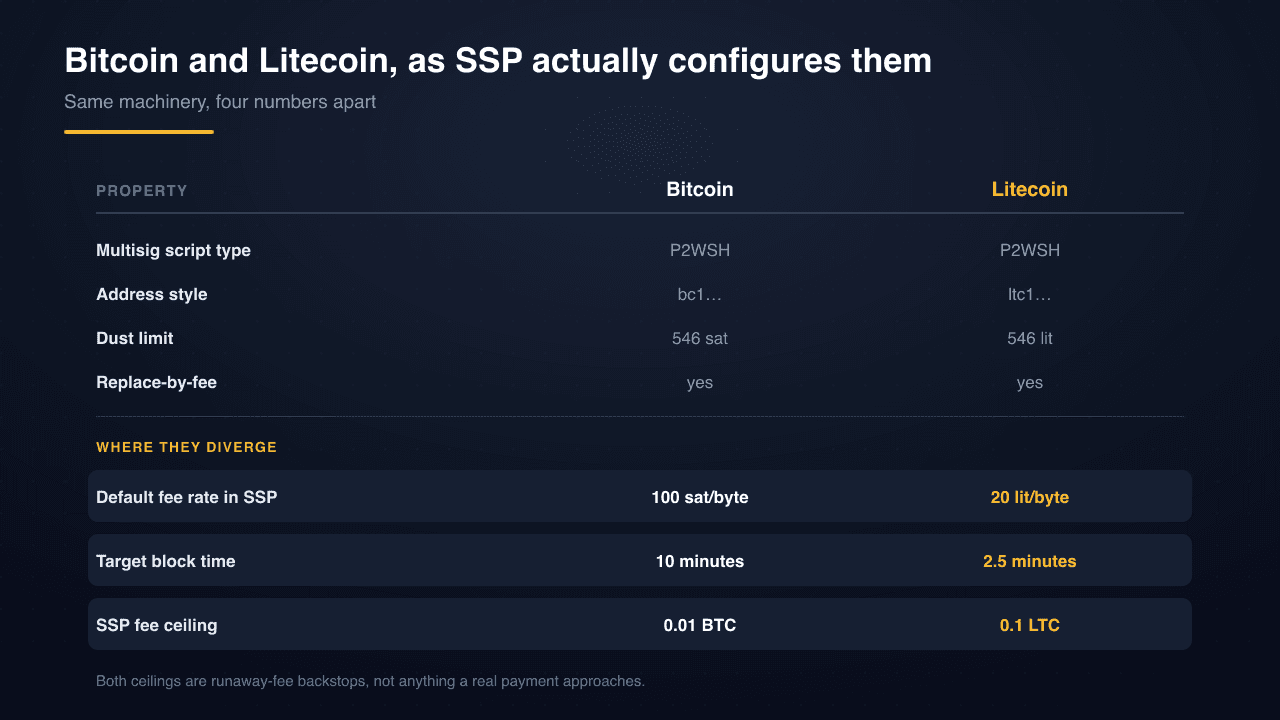
Your Litecoin 2-of-2 vault uses P2WSH, exactly like your Bitcoin one: native segwit, with addresses beginning ltc1 rather than bc1. The dust limit is the same 546 units. Replace-by-fee works the same way. The same seed phrase produces both, under a different SLIP-44 coin type, and both are protected by the same two devices.
There is no separate setup, no separate backup, and no chain-specific quirk to learn — which is precisely why Litecoin is a reasonable first chain to hold alongside Bitcoin rather than a second thing to manage.
Four minutes instead of ten
The most visible difference is block time. Litecoin targets 2.5 minutes per block against Bitcoin's 10.
The practical effect is not that Litecoin is "four times faster" in any meaningful security sense — a confirmation is a confirmation, and four Litecoin blocks represent less accumulated work than one Bitcoin block. What it changes is the feel of a payment. A first confirmation typically arrives in minutes rather than tens of minutes, which matters when you are standing at a counter or waiting on an exchange deposit rather than settling something that can take an hour.
For a two-device wallet the shorter block time is a small quality-of-life win: less standing around after the second signature wondering whether anything happened.
Fees, and why SSP's default is a fifth of Bitcoin's
SSP defaults to 20 units per byte on Litecoin against 100 on Bitcoin. That ratio is not arbitrary — it reflects that Litecoin's blocks are, in practice, not full.
Bitcoin has a real fee market. Block space is scarce, demand is spiky, and the fee you pay is a bid whose right level changes hour to hour. That is why Bitcoin fee strategy is a topic worth its own article. Litecoin has four times the block issuance rate and a small fraction of the transaction demand, so there is usually no auction to win. A typical 2-of-2 Litecoin payment costs a fraction of a cent, and the fee is not a decision you need to agonise over.
Two guard rails apply, as they do everywhere in SSP. Outputs below 546 units cannot be created, and SSP will never attach a fee above 0.1 LTC to a transaction — a backstop against a catastrophic bug, not a level any real payment approaches.
Because Litecoin supports replace-by-fee, a transaction stuck at too low a rate is recoverable rather than permanent. This is the opposite of the situation on Flux, where transactions expire instead. Neither is better; they are different answers to the same question of what should happen to a transaction the network hasn't accepted.
What SSP does not do: MWEB
Litecoin has an optional privacy extension called MWEB — Mimblewimble Extension Blocks — activated in 2022. It allows funds to be moved into a separate confidential layer where amounts and addresses are hidden.
SSP does not support MWEB. Your Litecoin balance in SSP lives entirely on the transparent chain, and every transaction you make is as publicly visible as a Bitcoin one. There is no toggle to change this, and if you send funds from SSP they land in the ordinary, transparent world.
This is worth stating plainly rather than leaving you to discover it. If confidential Litecoin transactions are something you need, SSP is not the wallet that provides them today, and no amount of careful address hygiene inside SSP will produce MWEB's properties. What SSP provides is custody: the balance is in a 2-of-2 multisig that requires both of your devices, and that guarantee is orthogonal to privacy.
The general privacy advice for transparent UTXO chains applies here as it does to Bitcoin — a new receiving address per payment, and awareness that consolidating outputs links them together. Consolidating UTXOs covers the trade-off between cheap future transactions and the privacy cost of merging your history.
Where Litecoin fits
Litecoin is usually described as silver to Bitcoin's gold. That framing is old marketing rather than analysis, and it obscures more than it explains.
The honest version: Litecoin is a long-lived, conservatively-run Bitcoin derivative with a much smaller market, faster and cheaper transactions, and no meaningful technical claim to being different from Bitcoin rather than being a cheaper version of Bitcoin. Its persistence for well over a decade is a real datapoint — most 2011-era forks are gone. Its lack of a distinct purpose is also a real datapoint.
What that means for how to hold it: Litecoin is reasonable as a transactional asset — the thing you actually move when moving Bitcoin feels expensive or slow — and a weaker case as a store of value, where Bitcoin's network effect is the entire argument and Litecoin has a fraction of it. Size the position accordingly.
Self-custody changes none of that analysis. It changes only who can take the coins away from you, which is the question what actually stops a transaction is about.
Getting started
Litecoin appears in SSP's chain switcher next to every other supported network. Select it, and you have a 2-of-2 vault derived from the seed you already backed up. Balances, portfolio value and transaction history behave identically to every other UTXO chain in the wallet.
The practical notes are few. Expect ltc1 addresses. Don't overthink the fee. Remember that your balance is transparent, not confidential. And if a transaction is taking longer than you like, replace-by-fee is available rather than a rebuild being required.
For the click-by-click walkthrough, sending Litecoin with SSP picks up from here.