Ravencoin in SSP: Assets, Fees, and the Fork That Rewrote Three Days
Ravencoin is the chain in SSP with the most specific purpose and, as of this August, the most instructive recent history. Both are worth understanding before you hold it.
Start with what it was built for, because it explains everything else.
A chain for issuing things that are not the coin
Ravencoin forked from Bitcoin in 2018 with one addition: a native asset layer. Anyone can create a uniquely named token on Ravencoin — PIZZA, SHARES/CLASS-A, whatever is unclaimed — and issue, transfer, and optionally freeze it, with no smart contract to write and no VM to trust. Asset rules live in consensus rather than in code you deploy.
That is a genuinely different design from putting a token on Ethereum. It is narrower, and in exchange it is far harder to get wrong: there is no contract to audit, because there is no contract.
SSP supports RVN the coin, not the asset layer. You can hold, send and receive RVN in a 2-of-2 vault like any other chain. Tokens issued on Ravencoin are not shown and cannot be sent. If assets are why you are interested in Ravencoin, SSP is not the wallet for that part of it, and no amount of poking around the interface will reveal a hidden setting — the support simply is not there.
The August 2026 consensus exploit
On 7 August, someone found a way to make Ravencoin accept blocks that had not done the work.
The KAWPOW block header carries an nHeight field. It was not checked against the block's actual position in the chain, and by manipulating that value an attacker could reach a validation path that skipped full proof-of-work verification and accepted a supplied mix hash without confirming genuine work had been performed. Forged blocks began appearing at height 4,487,776.
The response was fast and blunt. Mining pools holding a majority of the network's hashrate — 2Miners and RavenMiner among them — began mining a chain that excluded the exploited branch entirely, and an emergency patch locked a checkpoint at block 4,487,775, the last honest block. Exchanges including Upbit and Bitvavo froze RVN deposits and withdrawals. The price fell around 20%.
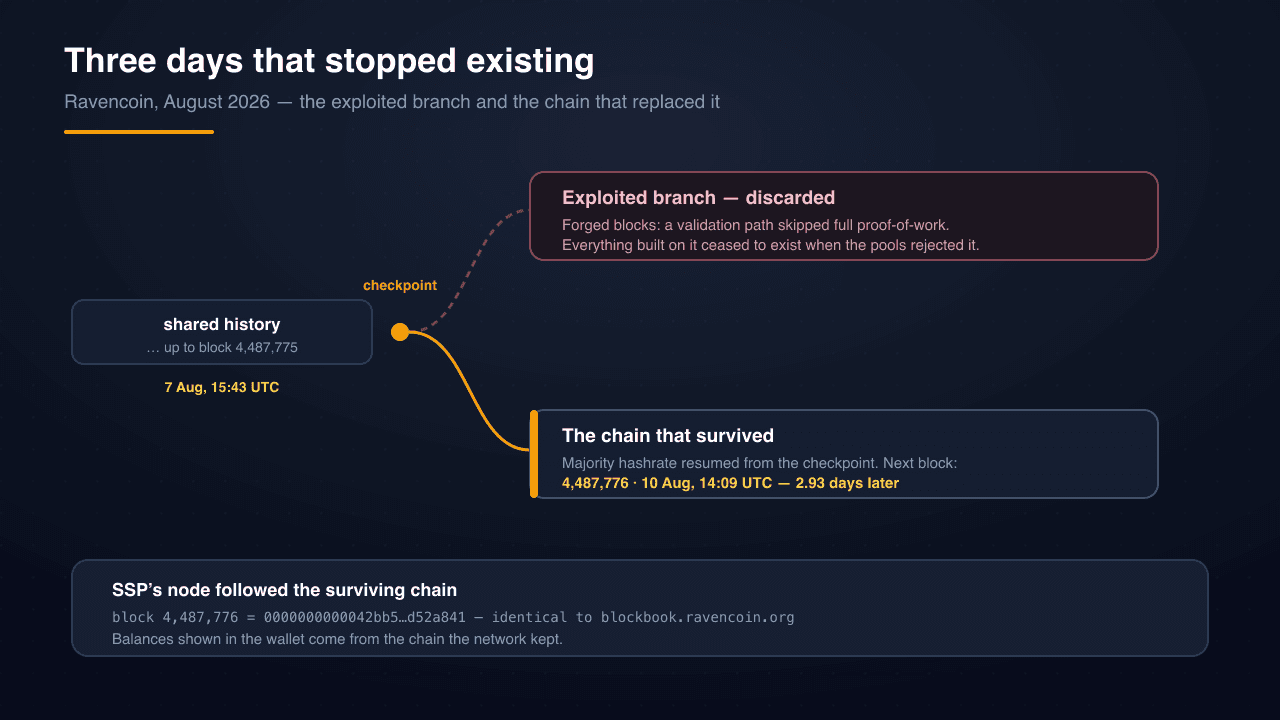
The consequence is visible in the chain itself, and it is stark. Block 4,487,775 was mined at 15:43 UTC on 7 August. The next block on the surviving chain, 4,487,776, was mined at 14:09 UTC on 10 August — nearly three full days later. Everything that happened on the exploited branch in between simply stopped existing.
Were SSP users affected?
No, and this is checkable rather than a matter of trust.
SSP's Ravencoin node follows the chain the network kept. Block 4,487,776 on our backend hashes to 0000000000042bb5…d52a841, identical to the same block on Ravencoin's official blockbook, with the same parent. The node runs a version well past the emergency patch and is fully synced.
So balances and history shown in SSP come from the surviving chain. Nothing needs re-checking and no action is required.
There is one exception worth stating plainly rather than burying. If you received RVN during that roughly three-day window, those incoming transactions existed only on the discarded branch, and they are gone — the coins were never really sent on the chain that survived. That is not an SSP bug and no wallet could have shown you otherwise; it is simply what a deep reorganisation means. Anyone in that position would need to ask the sender to send again.
What the incident is actually evidence of
It would be easy to write this off as one bug in one implementation, and easy to overstate it as proof the chain is broken. Neither is right.
The honest reading is about hashrate concentration cutting both ways. Ravencoin was rescued quickly precisely because a small number of pools control enough of the network to coordinate a response within hours and simply decide which chain was real. That is a genuine strength in an emergency — and it is the same property that, pointed the other way, would let those pools rewrite history against users rather than for them. On this occasion they acted in the network's interest. The structural fact is that they could.
Bitcoin's defence against this class of problem is not that its code has no bugs, but that its hashrate is too diffuse for anyone to coordinate a rollback. Ravencoin does not have that, and the August fork is what that difference looks like in practice.
None of which is an argument that the asset layer is a bad idea, or that KAWPOW's ASIC resistance was misguided. It is an argument for sizing a Ravencoin position as what it is: a smaller chain with a distinctive feature, a working development community, and a security budget that is a rounding error next to Bitcoin's.
How SSP handles Ravencoin
Ravencoin never adopted segwit, so your 2-of-2 vault is P2SH. Personal addresses begin with R; the multisig addresses SSP creates begin with r. Same seed, same two devices, same two-of-two arrangement as every other chain.
Fees look alarming and are not. SSP defaults to 1,050 units per byte against Bitcoin's 100, but a Ravencoin unit is worth a vanishing fraction of a satoshi — the same arithmetic that makes Dogecoin's fees look enormous and cost nothing. A typical payment is a fraction of a cent. The dust limit is the familiar 546 units, and SSP caps any single fee at 500 RVN as a runaway-bug backstop.
Replace-by-fee is supported, so a transaction stuck at too low a rate can be bumped rather than abandoned. Blocks target one minute, so confirmations are quick.
Getting started
Ravencoin appears in SSP's chain switcher with every other supported network, derived from the seed you already backed up.
Four practical notes. Expect R and r addresses. Don't worry about the fee. Remember that assets issued on Ravencoin are not visible in SSP — only RVN itself. And if you want to verify the chain question for yourself rather than take our word for it, block 4,487,775 is the checkpoint to look up.
For the step-by-step, what actually stops a transaction covers what the multisig does and does not protect against — a distinction this month made unusually concrete.